

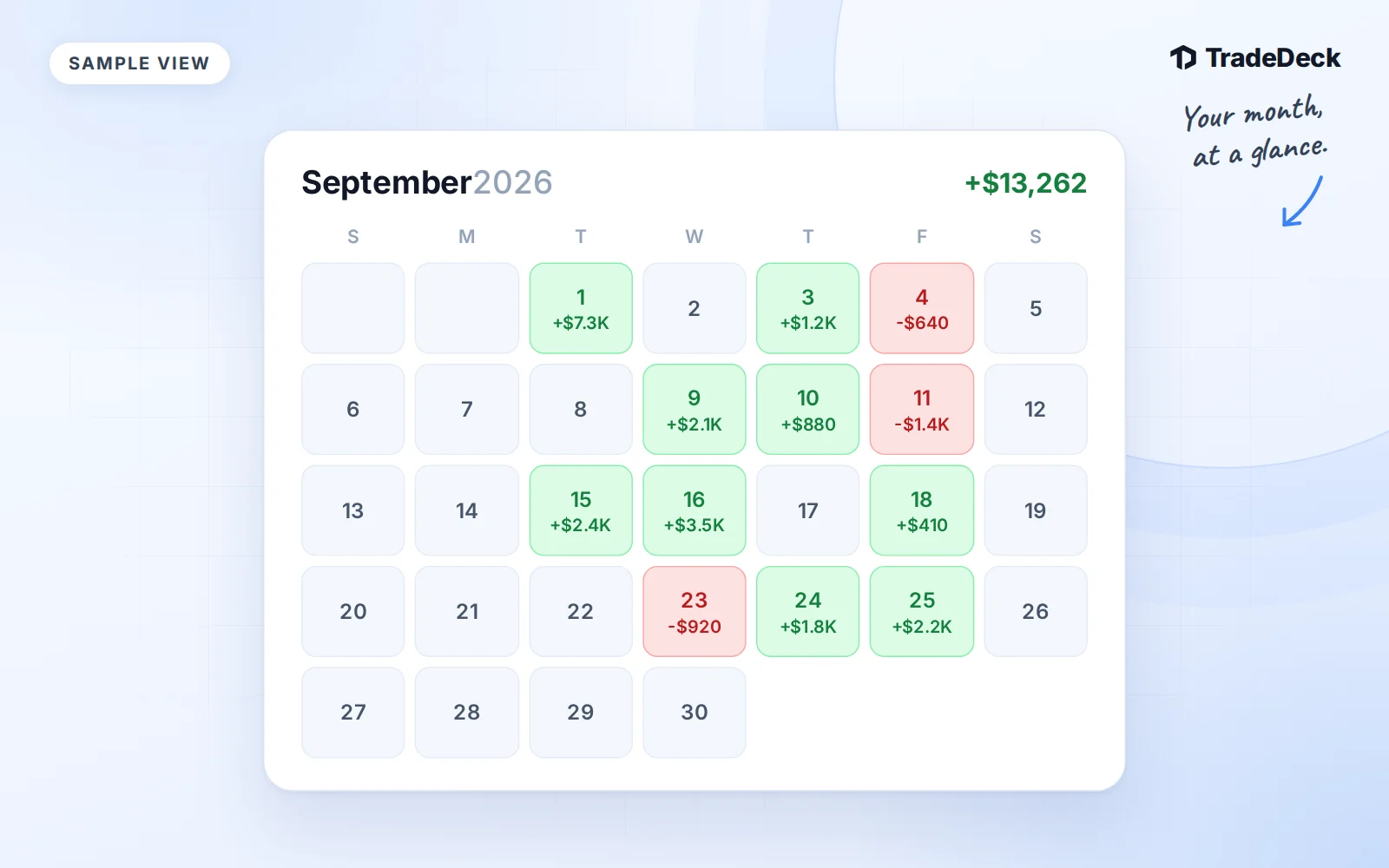
Performance calendar is one of the fastest ways to spot behavior patterns. You see streaks and problem days that raw tables hide.
Most traders start with motivation and lose consistency because the process stays vague. A professional journal removes guesswork. It shows which setups create expectancy, which symbols fit your style, and when discipline fails.
## Pattern Examples
Monday weakness, Friday risk spikes, or revenge strings after a red session. Those show up quickly in calendar format.
Practical detail matters here. Think about a Monday red streak and Thursday overtrading. If your journal cannot capture context, setup tag, and risk plan in one place, review quality drops quickly. Traders often blame mindset first, but weak data structure is usually the hidden problem.
Use concrete numbers when you review. For calendar heatmap, if 7 of 8 Monday opens are negative, reduce first trade size by 30 percent. Log your planned stop, actual stop, and slippage in dollars. That single habit reveals whether losses come from bad reads or from poor execution discipline.
Run a repeatable loop: log right after each trade, run a 10 minute end of day review, then do a deeper weekly review on Saturday. Compare setups by symbol, by time window, and by market regime. Patterns like overtrading after lunch or revenge trades after an early stop become obvious.
## What to Do With Patterns
Turn repeated issues into hard rules. For example, cut size after two red days, or avoid a weak session window.
Practical detail matters here. Think about a Monday red streak and Thursday overtrading. If your journal cannot capture context, setup tag, and risk plan in one place, review quality drops quickly. Traders often blame mindset first, but weak data structure is usually the hidden problem.
Use concrete numbers when you review. For calendar heatmap, if 7 of 8 Monday opens are negative, reduce first trade size by 30 percent. Log your planned stop, actual stop, and slippage in dollars. That single habit reveals whether losses come from bad reads or from poor execution discipline.
Run a repeatable loop: log right after each trade, run a 10 minute end of day review, then do a deeper weekly review on Saturday. Compare setups by symbol, by time window, and by market regime. Patterns like overtrading after lunch or revenge trades after an early stop become obvious.
## Review Cadence
Use a weekly and monthly pass. Weekly catches behavior drift, monthly confirms whether the rule changes helped.
Calendar view highlights red and green clusters
Back up calendar patterns with analytics
Practical detail matters here. Think about a Monday red streak and Thursday overtrading. If your journal cannot capture context, setup tag, and risk plan in one place, review quality drops quickly. Traders often blame mindset first, but weak data structure is usually the hidden problem.
Use concrete numbers when you review. For calendar heatmap, if 7 of 8 Monday opens are negative, reduce first trade size by 30 percent. Log your planned stop, actual stop, and slippage in dollars. That single habit reveals whether losses come from bad reads or from poor execution discipline.
Run a repeatable loop: log right after each trade, run a 10 minute end of day review, then do a deeper weekly review on Saturday. Compare setups by symbol, by time window, and by market regime. Patterns like overtrading after lunch or revenge trades after an early stop become obvious.
Detailed scenario: during a New York open session, log one concrete trade from plan to exit. Example, NQ long at 21105.25, stop at 21097.25, target at 21125.25, 2 contracts. That is 8 points of risk, $320 total risk, and 20 points of potential reward, $800 gross. When you write those numbers in the journal, you can quickly see whether your actual behavior matched your plan and whether the setup is still producing edge.